Local-First Worship Software

Sexuele Voorlichting 1991 Belgium [upd] Full Videotitle Porn Tube Install May 2026

G-Presenter is a worship presentation app built for simplicity. Manage songs, display Bible verses, set backgrounds, and sync to extra screens over your local network. No account required. Nothing stored in the cloud.

No account required. No subscription.

Operator interface preview
Local-first, no internet required
Fast local performance
3 Bible translations built in, import more
No account or subscription
Windows desktop app

Sexuele Voorlichting 1991 Belgium [upd] Full Videotitle Porn Tube Install May 2026

Entertainment in 1991 also saw a surge in "local-for-local" content. While Hollywood blockbusters and sitcoms like Married... with Children were ratings hits, there was a growing demand for Belgian-made fiction and game shows. This "media content" often walked a thin line between pure escapism and subtle social commentary. Even within variety programming, elements of "voorlichting" were often embedded, such as public health announcements or segments on new technology, as the country stood on the precipice of the digital revolution.

The year 1991 stands as a watershed moment for the Belgian media landscape, marked by a delicate balance between traditional public service broadcasting and the aggressive expansion of commercial entertainment. At the heart of this transition was the concept of "voorlichting"—the Dutch term for public information or education—which faced an identity crisis as the nation's media appetite shifted toward globalized content and private competition. Entertainment in 1991 also saw a surge in

Technologically, 1991 was a year of anticipation. The rise of cable television in Belgium—already among the most cabled regions in the world—meant that the average household had access to a dizzying array of international perspectives. This exposure forced Belgian content creators to elevate their production values. The "voorlichting" of 1991 was not just about the message; it was about the medium. High-quality graphics and professionalized studio sets became the new standard for delivering information, signaling the end of the austere, "talking head" style of previous decades. This "media content" often walked a thin line

The tension of 1991 was defined by the struggle to keep "voorlichting" relevant. Public broadcasters doubled down on investigative journalism and high-quality documentaries, attempting to distinguish themselves from the populist "infotainment" emerging on commercial channels. Shows that focused on consumer rights, health, and civic duties were revamped with faster pacing and more engaging visuals to prevent audiences from switching channels. This was the era where the "pedagogical" voice of the state began to soften, adopting a more conversational and peer-to-peer tone to maintain its authority in a crowded market. At the heart of this transition was the

In the early 1990s, Belgium was still navigating the aftermath of the 1989 "Media Decree," which had effectively ended the monopoly of public broadcasters like the BRTN (now VRT). By 1991, the commercial station VTM had firmly established its dominance in Flanders, forcing a radical rethink of how "voorlichting" was delivered to the masses. No longer could educational content exist in a vacuum; it had to compete with the high-gloss allure of American imports and local variety shows.

Ultimately, "voorlichting 1991 belgium entertainment and media content" represents a pivotal chapter in European media history. It was the year the Belgian audience transitioned from being "citizens to be informed" to "consumers to be won over." The legacy of this shift is still visible today, as the lines between education, information, and entertainment continue to blur in the digital age. 1991 taught the Belgian media industry that for information to be effective, it first had to be watched. AI responses may include mistakes. Learn more
Song Editor

What you see is what they see

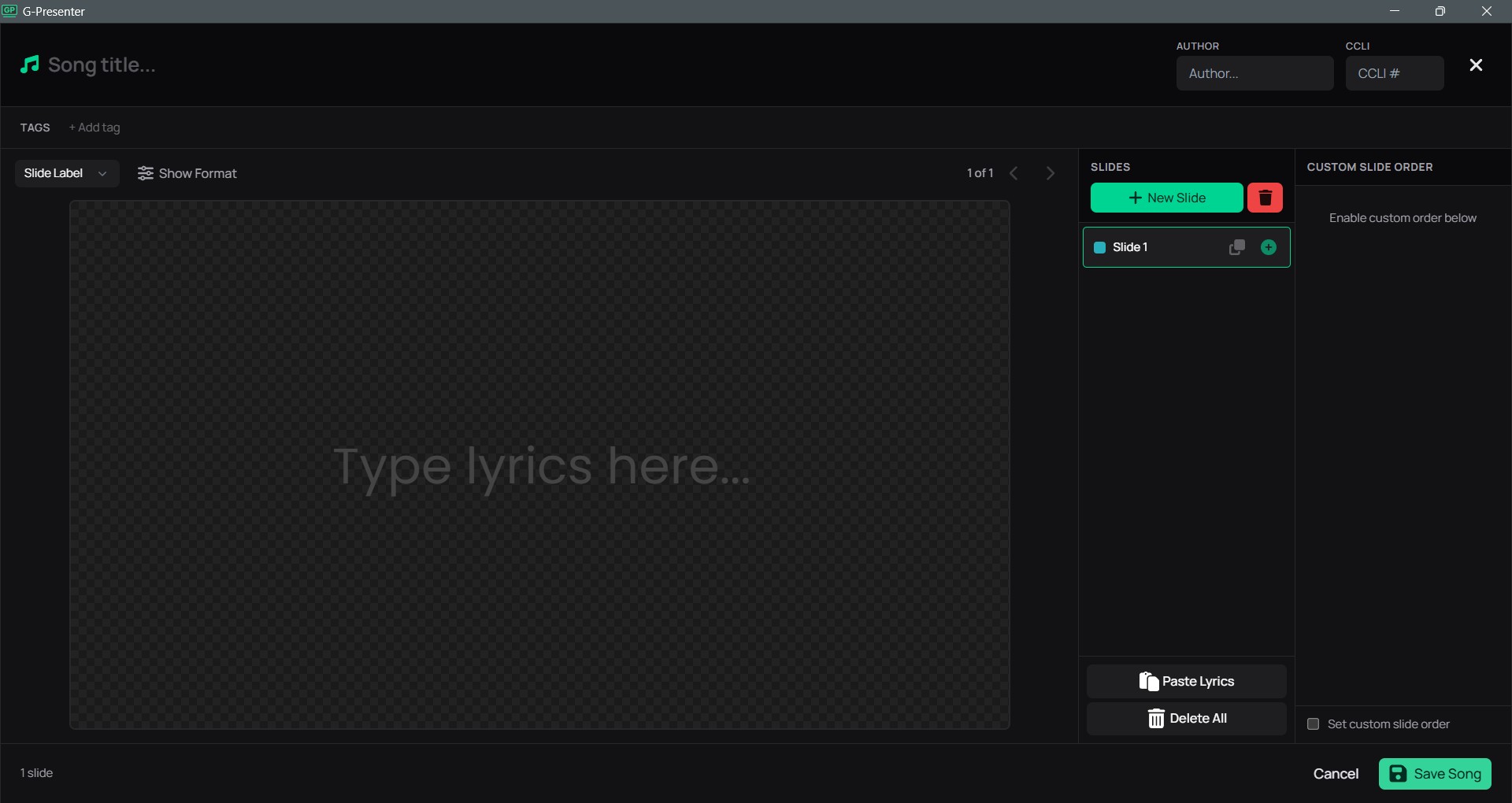
Edit your song slides on a full-size preview that matches the projector output exactly. The text automatically adjusts to fit, so what you design is what the congregation sees.

  • Press Alt+Enter to split lyrics into multiple slides. The text above stays on the current slide, and the rest moves to a new one right after it.
  • Paste lyrics from websites or Google Docs and the editor automatically cleans up the formatting, keeping only the plain text you need.
  • Customize each slide individually. Change the font, text size, spacing, and add colored text backgrounds with adjustable transparency.
  • Select any slide and press Delete to remove it instantly. No extra menus or confirmation dialogs to slow you down.
  • When you split a slide, labels update automatically. "Verse 1" becomes "Verse 1b", "Verse 1c", and so on, so your sections stay organized.
Song editor preview
Scripture Browser

Three translations built in. Import any language.

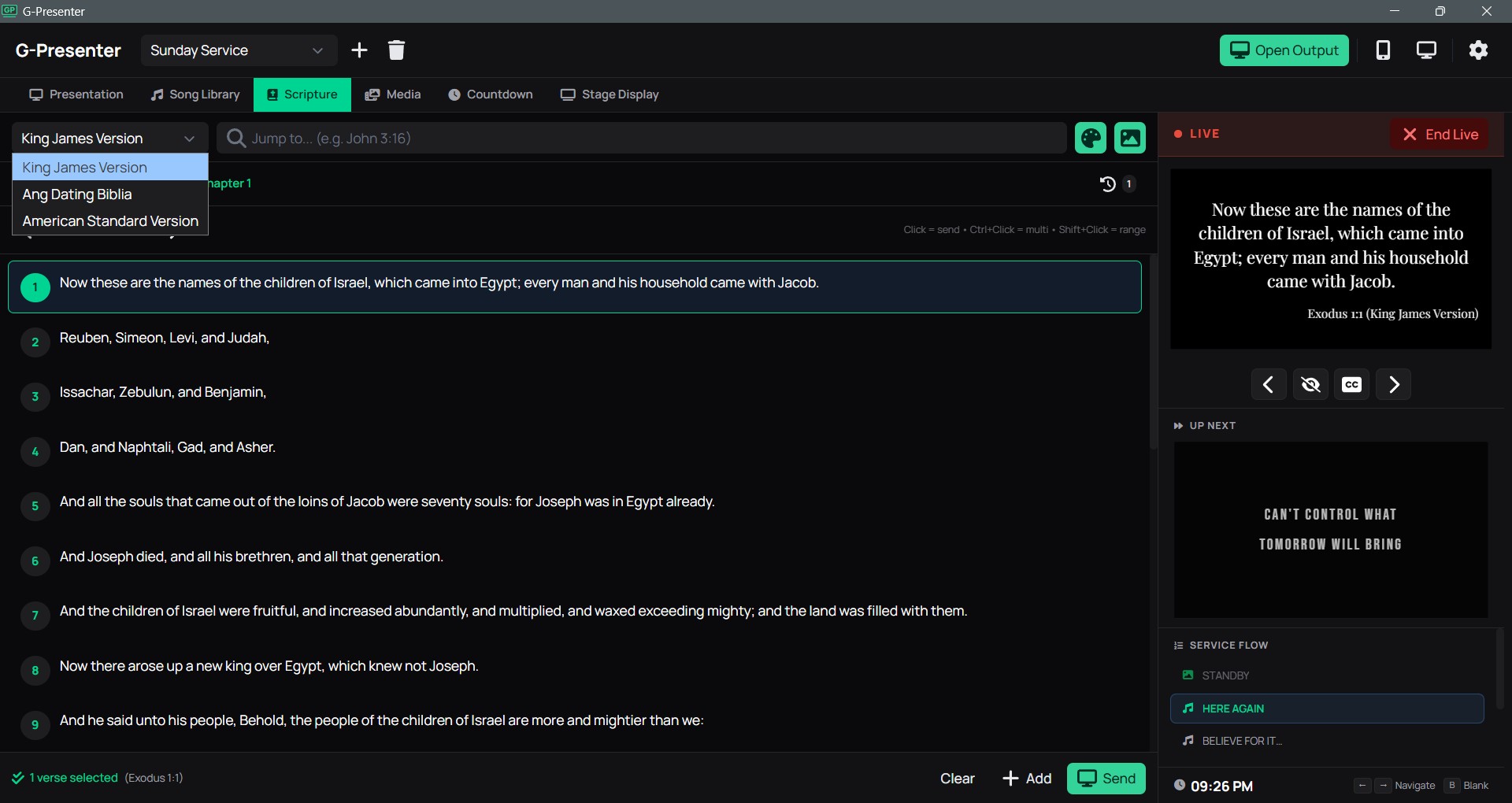
Browse the Bible by book and chapter, pick the verses you need, and display them on screen in seconds. Switch between translations mid-service without losing your place.

  • KJV, ASV, and Tagalog translations are already included. No downloading or internet connection needed.
  • Pro users can import additional Bible translations in any language, including Cebuano, Arabic, Spanish, and more. Hundreds of free translations are available in the open Zefania XML format.
  • Compare two or three Bible versions on screen at the same time. Choose side-by-side or stacked layout, and the text auto-fits to the projector. Works with both built-in and imported translations.
  • When you switch translations, the app stays on the same book, chapter, and verses. No need to navigate back to where you were.
  • Type a reference like "John 3:16" to jump straight to the verse. The app highlights it for preview first so you can confirm before sending it live. Search by verse content from a connected phone or tablet.
Scripture browser preview
Multi-Device Sync

Control from anywhere on the network

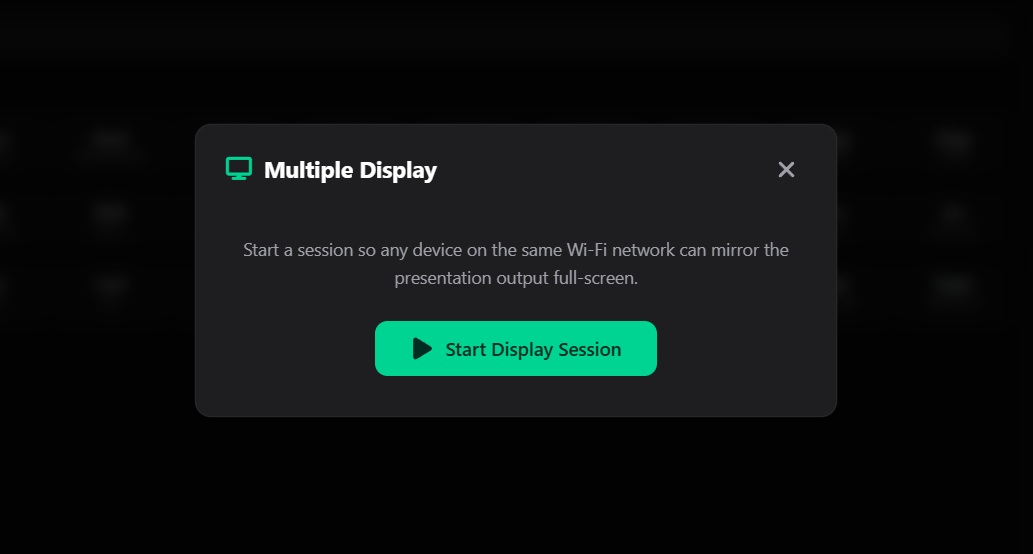
Show the same output on additional screens around the venue over Wi-Fi, and control the whole service from your phone. No extra hardware or special setup needed.

Up to 2 remote controls and 3 extra displays can connect at the same time. Background videos on extra displays show as thumbnails only for fast loading.

  • Slide changes appear on every connected screen almost instantly with no noticeable delay between the main display and the rest.
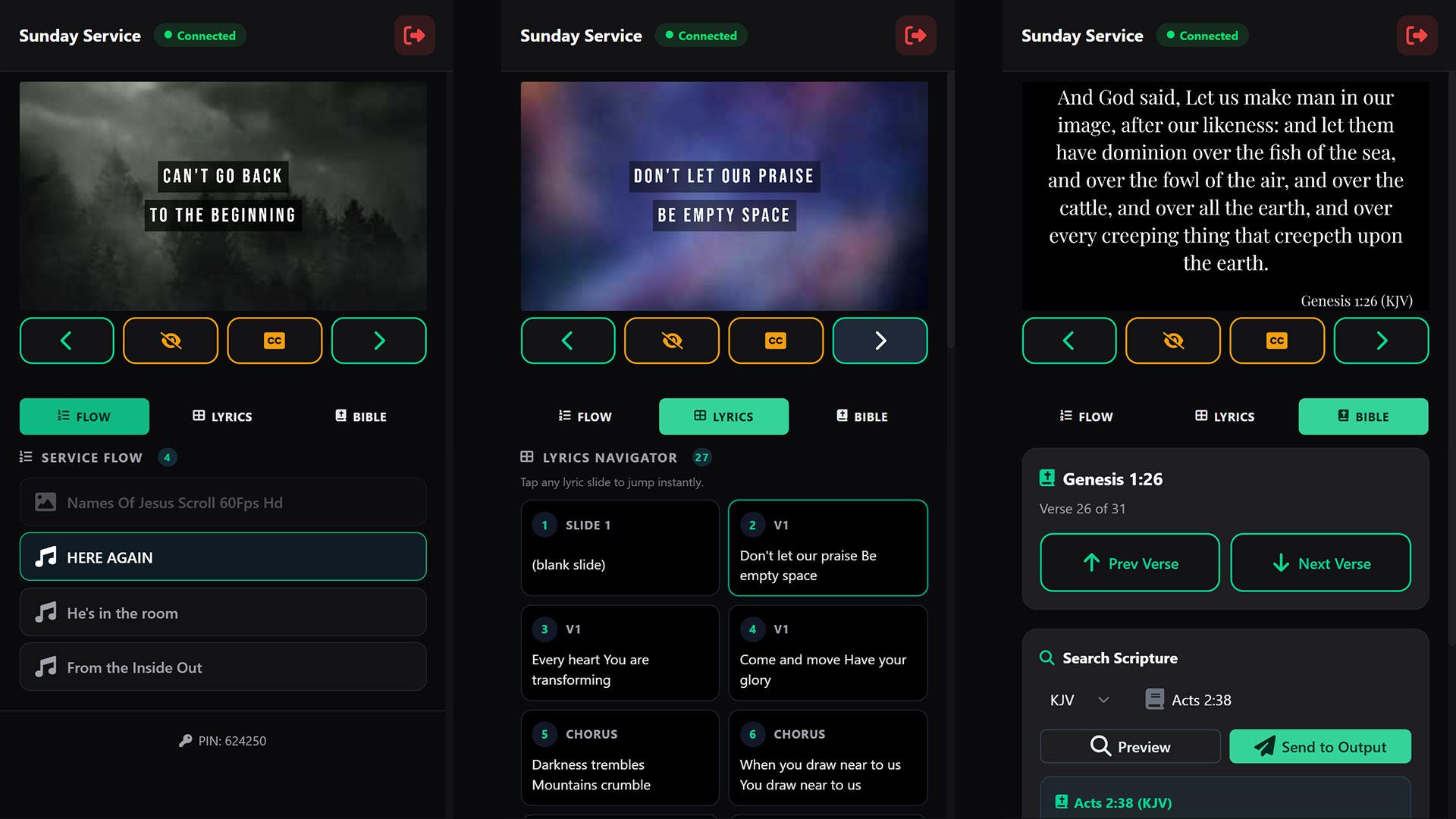
  • Scan a QR code on any device to open the remote control browser page instantly. No app install needed.
  • Remote control shows a live slide preview with forward, back, blank, and lyrics toggle. Tap any lyrics card to jump directly to that slide.
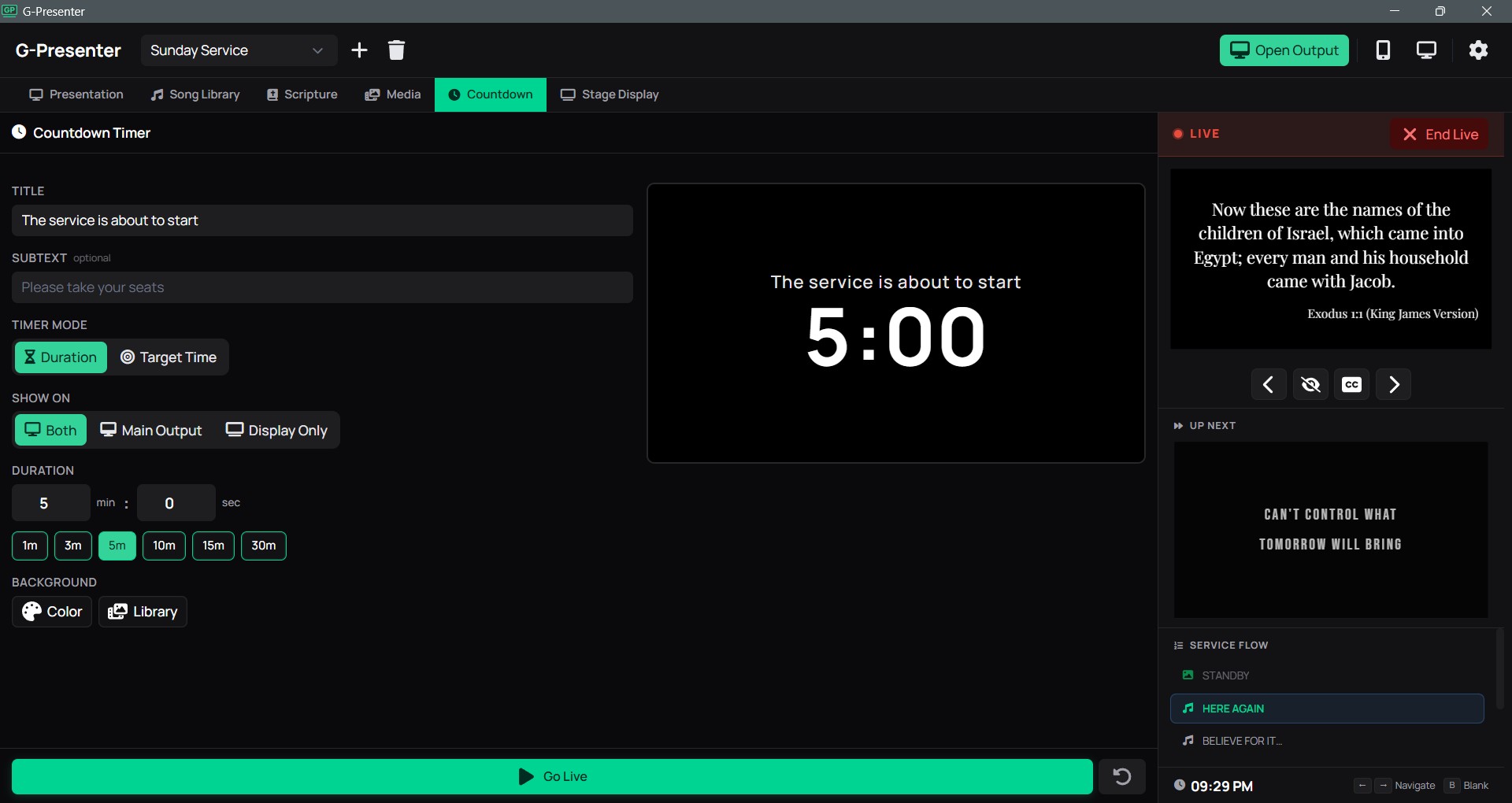
  • The countdown timer can be shown on the main projector, on extra screens, or everywhere at once. You choose.
  • Search for Bible verses directly on the remote device, preview the text, then send to the projector with one tap.
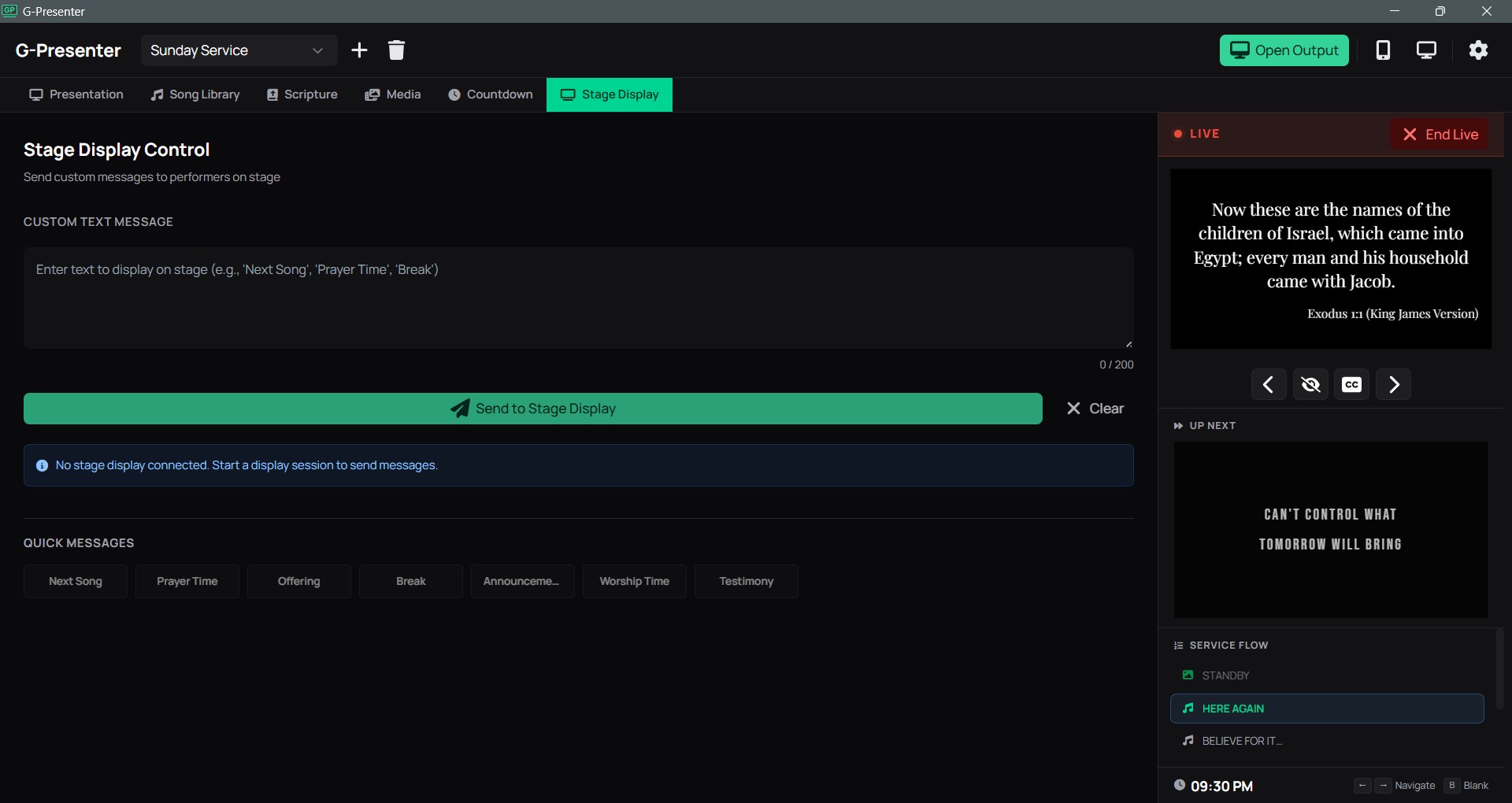
  • Switch any connected display to Stage Display mode for performers. It shows lyrics, custom messages from the operator, and a countdown in a 3-panel layout.
Multi-device sync preview
Interface

Designed for the operator

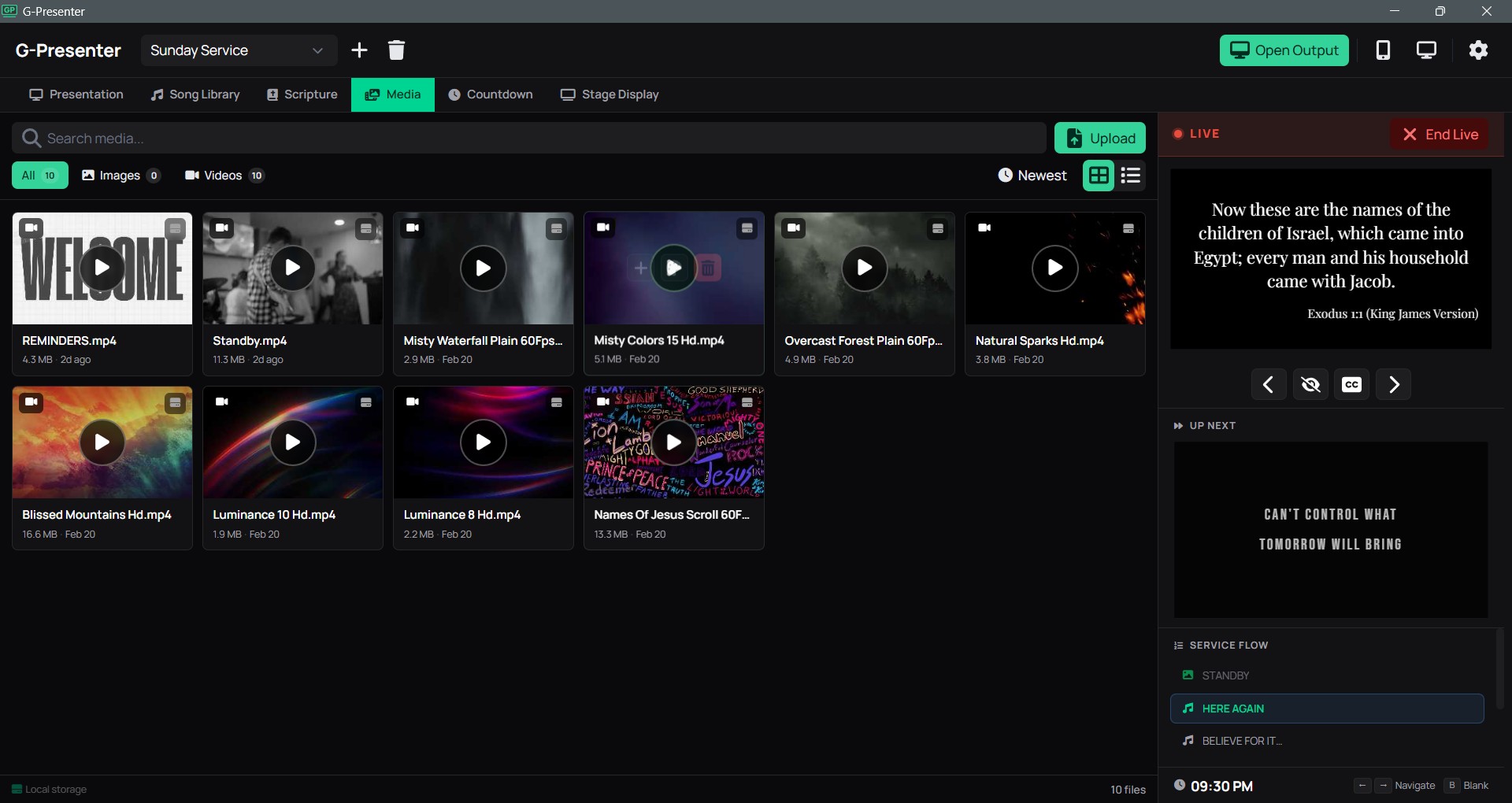
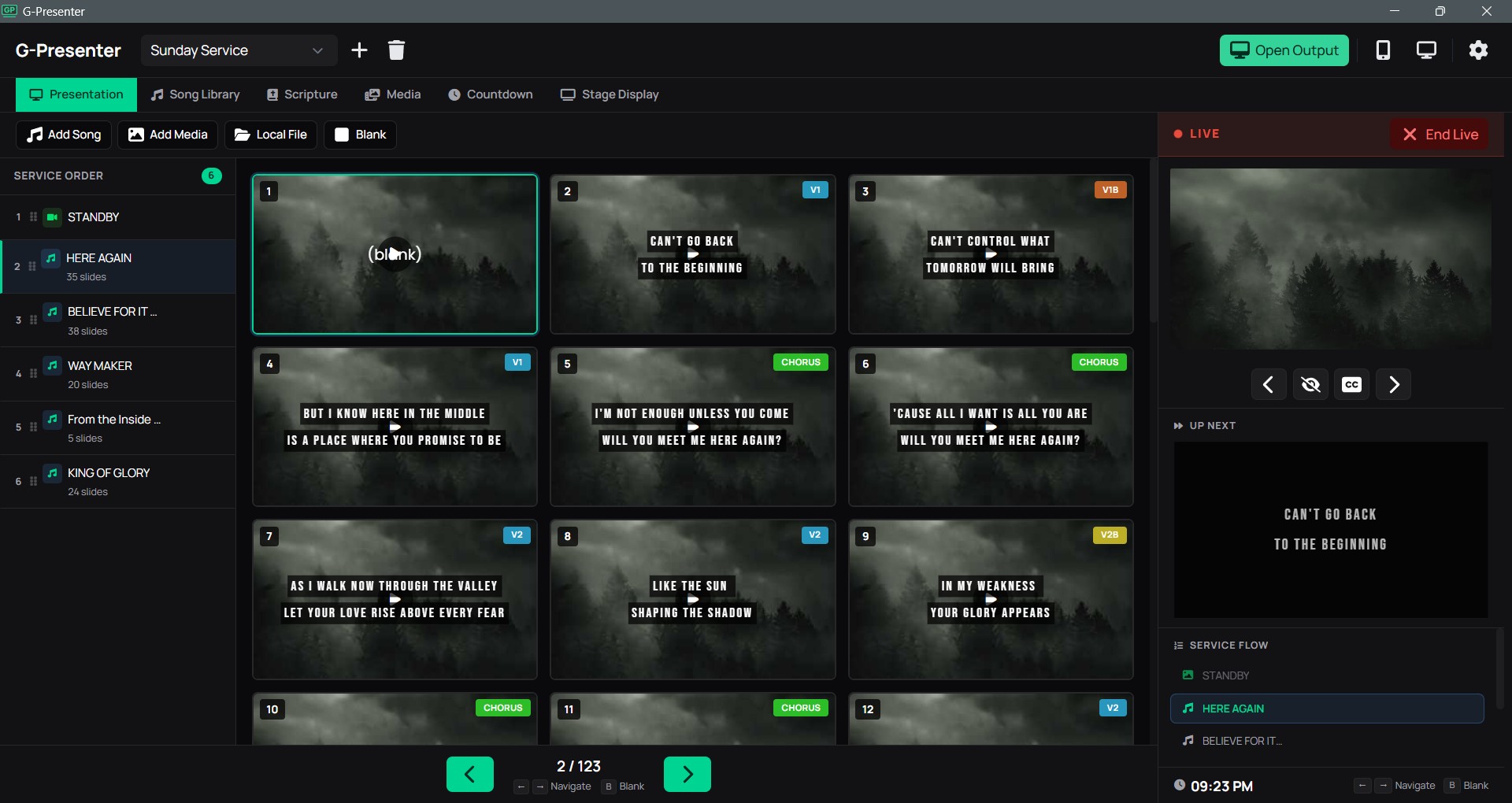
Every screen is designed to be fast and easy to use when it matters most. Switch slides, find songs, and pull up verses without missing a beat during a live service.

Presentation Control Panel
Presentation control panel screenshot
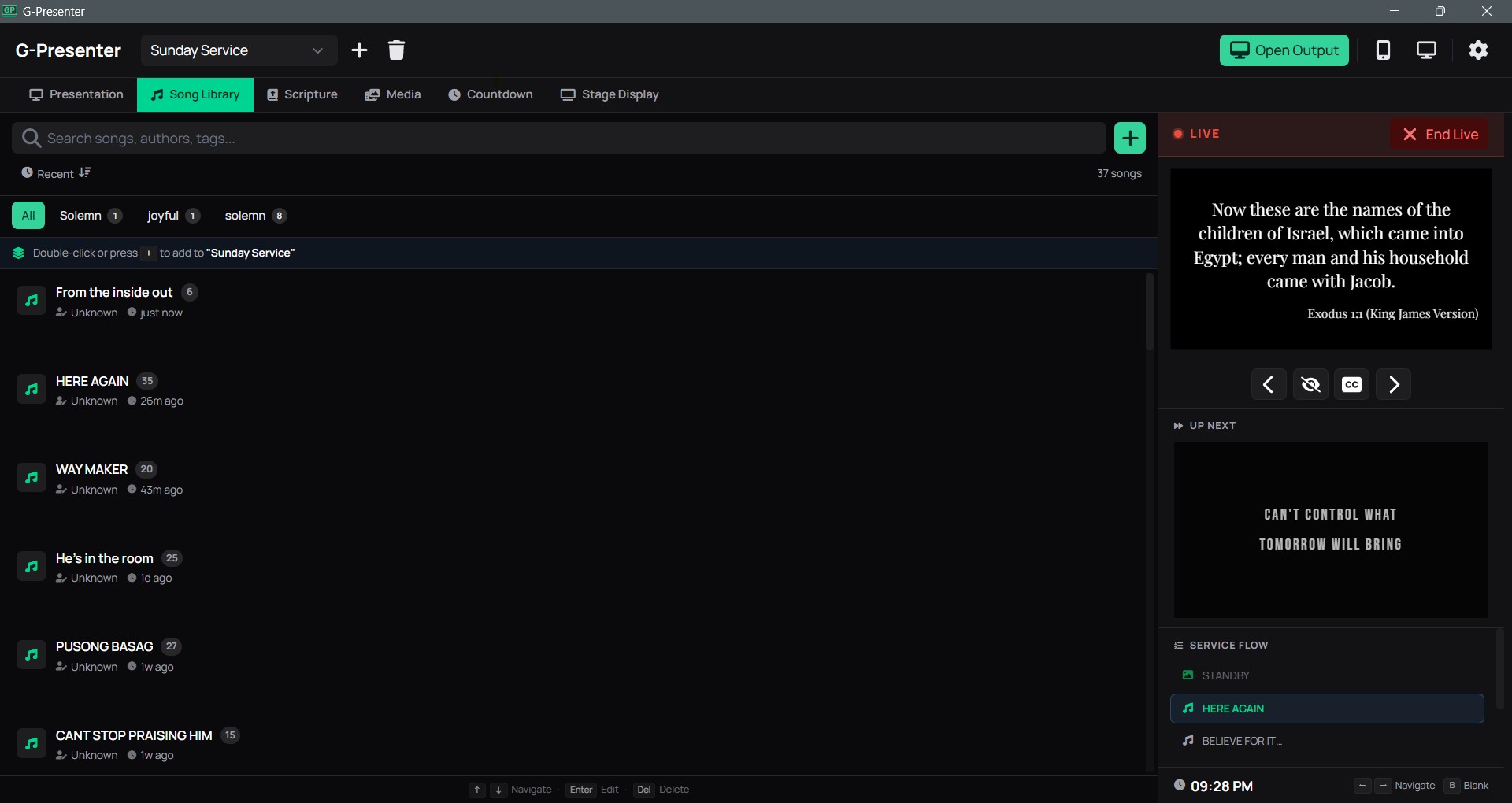
Song Library
Song library and editor screenshot
Countdown
Countdown screenshot
Mobile Remote Control
Mobile remote control screenshot
Media Library
Media library screenshot
Stage Display
Stage display control screenshot
3
Bible translations built in, import more with Pro
16:9 / 4:3
Projector aspect ratios supported
13
Languages supported out of the box
Windows
Native desktop installer available
Why G-Presenter

Built different, on purpose

Most worship software was designed for large churches with dedicated IT teams and annual budgets for software licenses.
G-Presenter was built for the rest of us.

Your data stays with you

Songs, Bibles, media, and settings are all stored on your own computer. Nothing is uploaded to the cloud. Your content is always available, always private, and always under your control.

Pay once, own it forever

No monthly fees. No yearly renewals. No "your subscription expired" surprises on a Sunday morning. You buy a license once and it works for the lifetime of that computer. Free updates for all v1.x releases included. And the free version has no watermarks or branding on your slides, ever.

Remote control from any phone

With Pro, open a browser on any phone or tablet connected to the same Wi-Fi and you have a full remote control. No app to install, no account to create, no pairing process. Scan the QR code and you are in.

Multi-display without extra hardware

Pro users can connect up to 3 extra screens and 2 remote controls over the local network. No video splitters, no HDMI extenders, no special cables. If the device has a browser and Wi-Fi, it can show your slides.

Bibles in any language, built in

Three translations come pre-installed with no download needed. Pro users can import hundreds of free Zefania XML translations in any language. Try doing that offline with most other tools.

Simple enough for volunteers

In most small churches, the person running the slides is a volunteer who does this once a week. G-Presenter keeps the interface clean and straightforward so anyone can pick it up without training.

Entertainment in 1991 also saw a surge in "local-for-local" content. While Hollywood blockbusters and sitcoms like Married... with Children were ratings hits, there was a growing demand for Belgian-made fiction and game shows. This "media content" often walked a thin line between pure escapism and subtle social commentary. Even within variety programming, elements of "voorlichting" were often embedded, such as public health announcements or segments on new technology, as the country stood on the precipice of the digital revolution.

The year 1991 stands as a watershed moment for the Belgian media landscape, marked by a delicate balance between traditional public service broadcasting and the aggressive expansion of commercial entertainment. At the heart of this transition was the concept of "voorlichting"—the Dutch term for public information or education—which faced an identity crisis as the nation's media appetite shifted toward globalized content and private competition.

Technologically, 1991 was a year of anticipation. The rise of cable television in Belgium—already among the most cabled regions in the world—meant that the average household had access to a dizzying array of international perspectives. This exposure forced Belgian content creators to elevate their production values. The "voorlichting" of 1991 was not just about the message; it was about the medium. High-quality graphics and professionalized studio sets became the new standard for delivering information, signaling the end of the austere, "talking head" style of previous decades.

The tension of 1991 was defined by the struggle to keep "voorlichting" relevant. Public broadcasters doubled down on investigative journalism and high-quality documentaries, attempting to distinguish themselves from the populist "infotainment" emerging on commercial channels. Shows that focused on consumer rights, health, and civic duties were revamped with faster pacing and more engaging visuals to prevent audiences from switching channels. This was the era where the "pedagogical" voice of the state began to soften, adopting a more conversational and peer-to-peer tone to maintain its authority in a crowded market.

In the early 1990s, Belgium was still navigating the aftermath of the 1989 "Media Decree," which had effectively ended the monopoly of public broadcasters like the BRTN (now VRT). By 1991, the commercial station VTM had firmly established its dominance in Flanders, forcing a radical rethink of how "voorlichting" was delivered to the masses. No longer could educational content exist in a vacuum; it had to compete with the high-gloss allure of American imports and local variety shows.

Ultimately, "voorlichting 1991 belgium entertainment and media content" represents a pivotal chapter in European media history. It was the year the Belgian audience transitioned from being "citizens to be informed" to "consumers to be won over." The legacy of this shift is still visible today, as the lines between education, information, and entertainment continue to blur in the digital age. 1991 taught the Belgian media industry that for information to be effective, it first had to be watched. AI responses may include mistakes. Learn more
Pricing

Simple, honest pricing

Use G-Presenter for free, forever. Upgrade to Pro for advanced features that help your worship team do more.

Free
0USD
Free forever, no account needed
  • Song Library & Editor
  • Presentation Builder
  • 3 Built-in Bible Translations (KJV, ASV, Tagalog)
  • Media Library & Backgrounds
  • Countdown Timer
  • Import & Export
  • Output on secondary screen
  • Import Additional Bible Translations
  • Remote Control
  • Multi-Display Sync & Stage Display
Launch Sale
Pro License
$19.99$24.99
One-time payment · Lifetime license per device
Launch price - goes up to $24.99 after first month
  • Everything in Free
  • Import Bible translations in any language
  • Remote Control via phone or tablet
  • Multi-Display Sync & Stage Display over LAN
  • Free updates for all v1.x releases
  • 15-day free trial included
  • No subscription, works fully offline

Contact for License Purchase

Email your Hardware ID to:

Download once, try Pro features free for 15 days. To upgrade, find your Hardware ID in Settings > License.

Ready to Upgrade?

Email your Hardware ID to purchase a license:

Find your Hardware ID in Settings > License

(Automated checkout coming soon!)

May God bless you!

Download

Get started today

Download G-Presenter and try all Pro features free for 15 days.
No account or subscription required.

Join the discussion group: facebook.com/groups/gpresenter. Everyone is welcome.

Loading downloads...

Windows Desktop

The full app with all features. Everything is stored on your computer, so your songs, media, and settings stay with you even without an internet connection.

Requires Windows 10 or later (64-bit)One-click installer (.exe)Includes 15-day Pro trial
Minimum specs
4 GB RAM500 MB disk spaceAny dual-core processor
Recommended
8 GB RAMDedicated GPU for video backgroundsSecond display or projector for output